
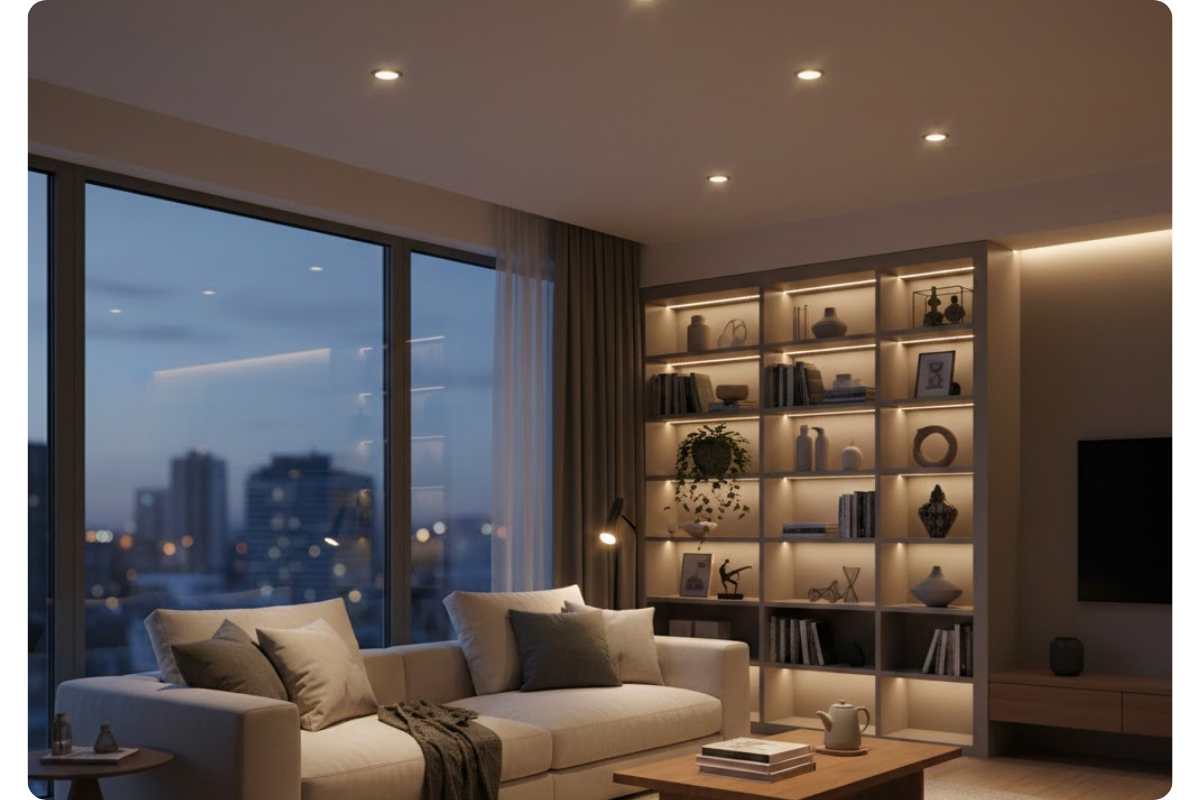
How many lumens should I get per downlight / per room (and what’s “bright enough”)?
For most Singapore homes, aim for 400–600 lumens per downlight in bedrooms and dining areas, and 700–900 lm per fitting in kitchens and living rooms.
Multiply your floor area (m²) by 300–500 to get your total lumen target, then divide by the number of downlights planned.

Table of Contents
- Why lumens matter more than watts
- What "bright enough" actually means
- Recommended lumen ranges (SG homes):
- Comparing 500 lm vs 800 lm downlights
- FAQ
Why lumens matter more than watts
- Here's the simple truth: watts measure power consumed, not brightness.
- Lumens measure actual light output.
- Ever since LED replaced fluorescent, watts became unreliable as a brightness guide.
- A 7W LED downlight can outshine a 20W older fitting what matters is the lumen count.
What "bright enough" actually means
"Bright enough" isn't one number. It depends on three things:
- Room function : task areas need more light than lounging spaces
- Ceiling height : higher ceilings (common in condos) spread light wider, reducing effective brightness
- Number of downlights : total room lumens = lumens per fitting × number of fittings
A useful rule of thumb: aim for 300–500 lumens per square metre for living areas, and 400–600 lm/m² for kitchens and study rooms.
Recommended lumen ranges (SG homes):
|
Room |
Lumen / Downlight |
LED Wattage Equivalent |
Idea |
|
Living Room |
700–900 lm |
9–12W |
Comfortable overall lighting for daily use; keep lights at least 0.5 m away from fan blades |
|
Bedroom |
400–600 lm |
5–7W |
Soft lighting for rest and comfort; choose surface or recessed lights based on your ceiling |
|
Kitchen |
700–900 lm |
9–12W |
Place lights closer together (1.2–1.5 m) to avoid shadows while cooking |
|
Bathroom |
700–900 lm |
9–12W |
Brighter lighting for daily tasks, especially near the mirror |
|
Hallway |
400–600 lm |
5–7W |
Basic lighting for safe and easy movement |
|
Dining Room |
700–900 lm |
9–12W |
Warm, comfortable lighting; dimmers help create a cosy mood |
Fast checks (use these to avoid “too dim”):
- If you want a cosy feel: choose the lower end of the lm/sqm range + 3000K.
- If your room has dark floors/cabinets: add ~10–20% more lumens.
- If you do not have a false ceiling and lights must be fewer, pick higher-lumen downlights (e.g., ~1,200 lm) or add a secondary light.
Comparing 500 lm vs 800 lm downlights
| Feature | 500 lm Downlight | 800 lm Downlight |
|---|---|---|
| Best for | Bedrooms, dining, corridors | Kitchens, living rooms, studies |
| Ceiling height | Up to 2.7 m | 2.7 m and above |
| Spacing | Every 1.2–1.5 m | Every 1.5–2 m |
| Dimmer compatible | Usually yes | Check product spec |
| Energy draw (typical LED) | ~5–6W | ~8–10W |
FAQ
Q: My BTO living room feels dim, do I need more lumens or more fittings?
A: Usually more fittings at the right spacing; adding fittings distributes light more evenly than simply swapping to higher-lumen bulbs.
Q: What lumens should I get for a HDB corridor?
A: A 200–300 lm downlight per fitting is sufficient for a narrow HDB corridor.
Q: Will my existing wiring support higher-lumen downlights?
A: Check with a electrician, most modern HDB circuits handle LED downlights easily, but any new points require proper permits.
Q: Is 800 lm too bright for a condo bedroom?
A: It can be pair it with a dimmer switch so you control intensity for sleep versus getting-ready routines.
Q: Where can I browse downlights with lumen specs clearly listed?
A: Goldberg Home's downlight collection lists lumen output, beam angle, and colour temperature for easy comparison before you buy.

Written by Goldberg Home SG

%20by%20300%E2%80%93500%20to%20get...)